AI DISCOVERY
SEO and LLM optimization for AI search
For businesses whose best content already exists, but is not structured clearly enough for search engines, AI answer engines, and research agents to understand and cite.
Also described as
- LLM SEO
- AI search optimization
- answer engine optimization
- AI discovery optimization
What matters
The short version.
01
Make the site's entity, services, proof, and topical expertise clear to humans first, then machine-readable.
02
Build pages around real search intent instead of keyword stuffing.
03
Use crawlable content, structured data, internal links, media, and optional text endpoints together.
The three layers
One job, three labels: SEO, LLM SEO, and GEO.
When the content already exists, the missing ingredient is rarely effort — it is legibility. Google's generative AI search guidance treats answer-engine and generative-engine optimization as extensions of SEO, which makes the three labels below layers of a single job rather than three competing strategies. Read them in order, because a page no crawler can reach never becomes a page an assistant can quote.
01· Foundation
Traditional SEO
Get into the index. Earn the click or the snippet.
- Crawlability, indexation, speed, and internal linking still gate everything.
- No rank in Google or Bing means no reliable source material for AI downstream.
- Google's AI features rely on core Search ranking and quality systems.
Live demo
See what legible looks like from outside.
Ask an assistant what Buzzed Technologies is and watch which pages it reaches for. Nothing here is paid placement — it is the Buzzed Method run on our own domain.


The diagnosis
Why good content stays invisible.
AI search still needs clear source material
When people ask Google or an LLM who to hire, the answer is shaped by crawlable pages, search indexes, visible proof, citations, structured context, and entity consistency. If the site is vague, the model has little to work with.
The page has to answer the query
A homepage can explain the brand, but it rarely captures specific searches like AI consulting for small business, custom internal tools, SaaS replacement, or LLM optimization. Those need focused pages with real substance.
Schema helps, but content carries the weight
Structured data, sitemap coverage, clean metadata, and optional llms.txt files can help machines parse the site. The visible page still has to be useful enough for a human buyer to trust.
Proof on this site
The signal stack behind an answerable site.
Instead of describing an ideal architecture, here is the one holding up the page you are reading. None of it is exotic. It is the ordinary work of making a business describable to something that has never met you.
Measured on this domain
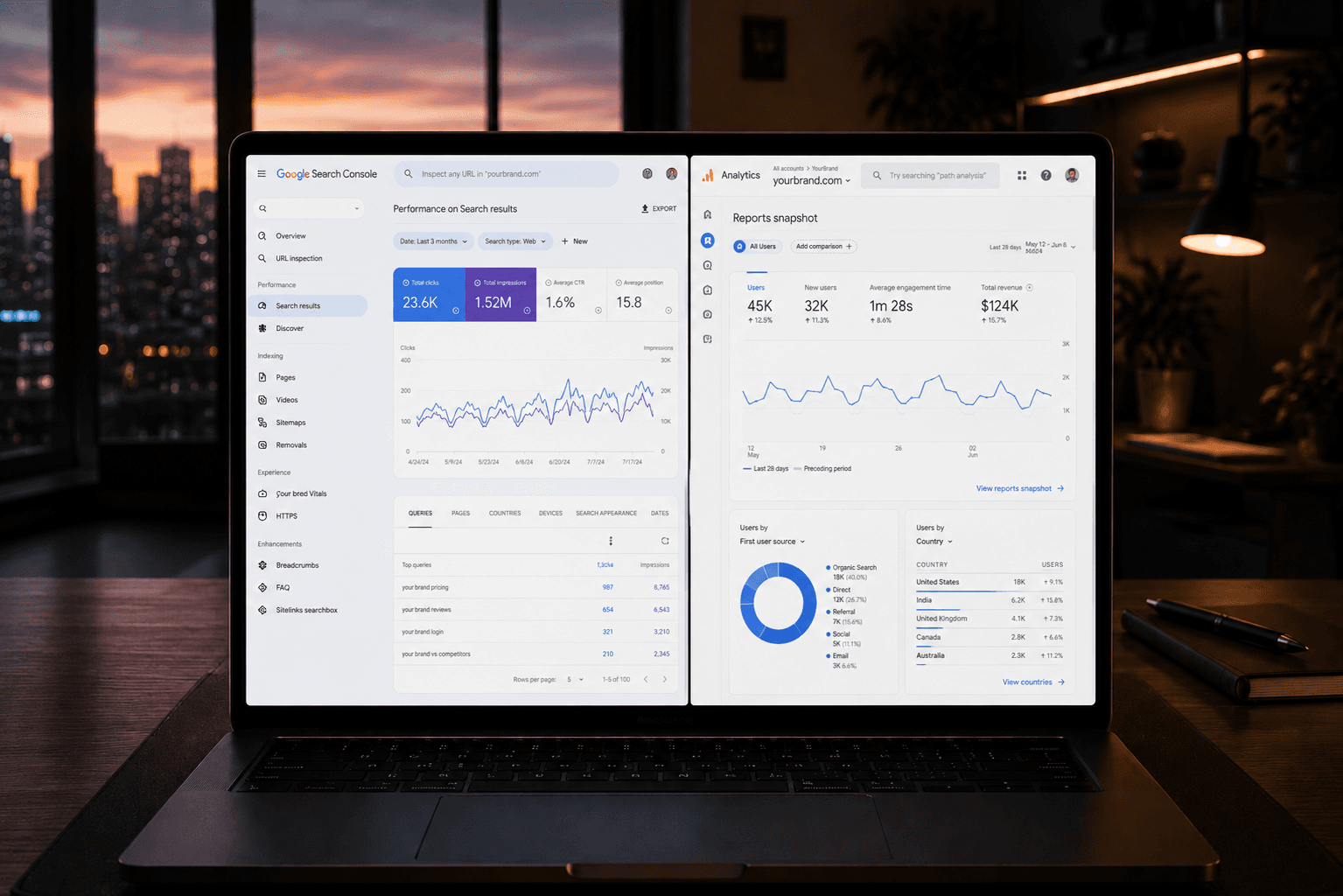
The same method, run on buzzedtech.com. Ninety days in Google Search Console.
- +129%
- Search impressions
- 2.2×
- AI Overview impressions
- 86%
- of recent days cited in AI answers
- 4×
- Daily search volume
Final 30 days versus the first 30. Google Search, this domain.
Last 28 days versus the first 28, in Google’s AI Overviews and AI Mode.
AI Overviews and AI Mode now cite the site on most days. That was not true in May.
How much more often the site appears in Google Search than it did in May.
Source: Google Search Console, Web Search, May 16–August 15, 2026. Equal-length windows compare the start and end of each export. Daily volume compares May 16–31 with August 1–15.
Proof on this site
Buzzed discovery architecture map
One page per question people actually ask
Every service, use-case, case-study, and field-note page on this domain exists because a buyer asked about it out loud. That is the reason an assistant summarizing us has something specific to quote instead of category boilerplate.
Nothing important hidden behind a render
Copy ships in the HTML, canonicals point one direction, the sitemap stays current, and related pages link to each other. A crawler that cannot finish the job has nothing to hand an answer engine.
Typed context that agrees with the visible page
Organization, Service, BreadcrumbList, Article, and FAQPage markup appear only where the page on screen already backs the claim. Schema that contradicts the copy is worse than no schema at all.
Text endpoints for the agents that want them
/llms.txt and /llms-full.txt condense who we are, what we ship, and what we have proven, for assistants that go looking for a map. Optional on purpose: Google does not need them, and no page here depends on them.
Asking the question again next month
Visibility is not a launch state. We re-run the same brand and category prompts on a schedule, watch which pages get cited, and repair the source material when the answer starts drifting.
Worth repeating, because the market keeps selling the opposite: Google states plainly that no special AI file, chunking scheme, or AI-only rewrite is required for its generative features. We ship agent-friendly context because it is cheap and some assistants use it. The leverage is still in having pages worth citing.
The work
What we change to make content legible.
Four fronts, worked in parallel, all of them aimed at the same outcome: a site that a person can trust and a machine can summarize without guessing.
Search-first technical foundation
Crawlability, indexation, sitemap coverage, canonical hygiene, Core Web Vitals, JavaScript rendering, semantic HTML, and snippet eligibility: the fundamentals Google says still gate AI visibility.
Non-commodity content architecture
Service, use-case, and field-note pages that answer real buyer questions with first-hand proof, named examples, useful media, and a point of view competitors cannot clone.
Entity and source clarity
Consistent company, service, founder, product, and proof details across visible content, internal links, JSON-LD, case studies, and reputable third-party references.
AI answer monitoring and iteration
We test how search and assistants describe your category today, fix missing source material, and refresh important pages when there is new expertise, proof, or product detail to add.
How we ship this
Five-step GEO engagement timeline
Audit01 · Audit
Index02 · Index
Content03 · Content
Structure04 · Structure
Measure05 · Measure
Data points
What Google actually says.
Each figure links out to where it came from. A typical range tag means the number comes from our own engagements and has no published study behind it.
Still SEO
Google's official guidance: optimizing for generative AI search is optimizing for the search experience
Required
pages must be indexed and eligible for a Google Search snippet before they can appear in Google's generative AI features
Core
Google's guidance prioritizes unique, helpful, people-first content over commodity pages or AI-search hacks
Foundational
crawlability, JavaScript SEO, page experience, and duplicate-content control remain core to AI search visibility
Helpful
structured data can support rich results, but Google says there is no special schema required for generative AI search
Optional
llms.txt and other special AI files are not required for Google's generative AI search features
Data points
Citation share over time
8 category queries · monthly re-test
- ChatGPT
- Perplexity
- Claude
- Google AI
Where this shows up
Sites we have made legible.
Buzzed Technologies (this site)
We use the same foundation on our own domain: crawlable service and use-case pages, canonical metadata, JSON-LD that matches visible content, a generated sitemap, field notes with first-hand POV, and optional /llms.txt context for assistants that choose to read it. Try the live demo on the service page: ask ChatGPT, Gemini, or Claude what Buzzed is.
Real engagement, dogfooded
Armonk-Somers Podiatry — specialty practice, Westchester NY
Replaced a static brochure site with crawlable service and FAQ pages, structured content assistants can parse, and a safeguarded AI assistant—giving search engines and LLMs specific source material about the practice instead of one generic landing page.
Real engagement
Read the case study →Common questions
Straight answers before you commit.
Can you guarantee placement in AI answers?
No one can honestly guarantee that. What we can do is make the site easier to crawl, understand, cite, and match to the right non-branded searches.
Is LLM optimization different from SEO?
It overlaps heavily with technical SEO, content strategy, and entity clarity. Google's guidance treats GEO and AEO as extensions of SEO, not replacements. The extra work is checking how AI assistants retrieve, summarize, and cite public web content.
Do llms.txt files matter?
They are optional. Google does not require llms.txt for AI Overviews or AI Mode. We treat it as a low-cost map for assistants and agents that choose to inspect it, not as a ranking lever or substitute for strong pages.
Related services
How this gets delivered.
SEO & LLM Optimization
Google's AI features still start with strong SEO: useful pages, crawlable structure, and clear source material. We help your site become the answer buyers can find, trust, and cite across Google Search, AI Overviews, ChatGPT, Claude, and Perplexity.
Web Design & Development
Beautiful sites built for humans and machines. Your content needs to convert visitors AND be understood by LLMs when prospects ask them to research you.
AI Strategy & Consulting
Not sure where AI fits? We map your operations, identify high-impact opportunities, and build a roadmap that makes sense for your budget and timeline.
Custom AI Development
Your business has unique challenges. We build AI solutions tailored to your specific workflows, data, and goals, not one-size-fits-all tools.
Free assessment
Get a free AI impact report for your business.
Before you change a single page, it helps to know where AI is actually pointed at your industry. Describe your business and we'll generate a tailored impact report covering the shifts worth planning for, discovery included. Free, and about two minutes.
Next step
Make the site answer the searches buyers actually make
Tell us the searches you want to appear for. We will map the pages, schema, and content needed to earn those matches.